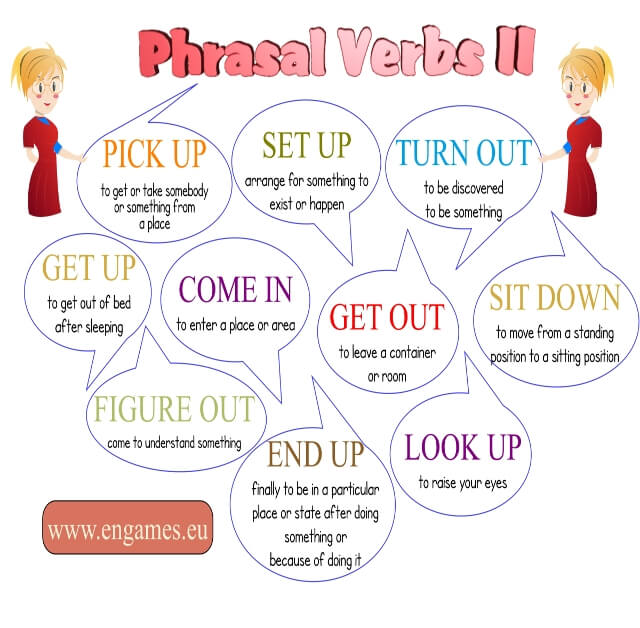
Phrasal verbs II
Yesterday I published a post in which I taught 16 phrasal verbs which belong among the 50 most frequent phrasal verbs in English. In this post I am going to introduce 10 more phrasal verb which belong into the same category.
For students who do not use articles in their mother tongue it is incredibly difficult to learn to use them correctly in English. In fact, it is very difficult to teach them use the articles at all. That is why I often spend a lot of time teaching definite and indefinite articles in English. <!–…
Imagine that even your most challenged students understand new grammar? Imagine that they discover the rules themselves? Imagine that your students ask you to test them on the topic you have just taught. All these things have happened to me after I started to use colourful teaching.
The past tenses of the modal verbs MUST, CAN and CAN’T often cause problems, even for advanced students of English. I have heard some of my best students, who had already passed the CAE exam, use words like MUSTED, and I was not happy about it. That is why I try to teach this grammar…
Recently I have been dealing with the modal verbs. First I created a mind map depicting all the modals in present and past tenses. That post was suitable for intemediate students. Then I wrote a post about the modal verbs Must and Should which was for elementary students. In this post I would like to…
Recently I have created a set of videos to teach the past simple tense in English. There is a video that helps students learn to form the past tense in the following situations:
The verb TO BE is the most important verb in English. Unfortunately, it is the most irregular verb in English, too. However, as all students of English manage to master its forms in the end, there is no reason to dispair. This mastery comes through practise. In this post I would like to share with…
This site uses Akismet to reduce spam. Learn how your comment data is processed.
Very useful
Thank you.
This delightful quiz game is perfect for teaching or revising phrasal verbs. A grid is drawn on the board with points at the top and verbs down the side. The students play a quiz game by guessing phrasal verbs from their definitions. The first student to raise their hand and give the correct phrasal verb wins that square for their team and the amount of points in the square. The team with the most points at the end is the winner. As an extension, when a student answers correctly, the team makes a sentence using the phrasal verb. If it is correct, they receive double points for the square.
Thank you. This looks wonderful.
Thanks a lot for your beautiful and helpful article, its a great Idea to learn not only phrasal verbs but also new words.
In this memorable teaching activity, students write sentences with phrasal verbs. The class is divided into small teams. The teacher writes a verb on the board. In their teams, students have five minutes to write as many sentences as they can, using the chosen verb as a phrasal verb. After five minutes, the teacher asks each team for their sentences. For each sentence where the meaning of the phrasal verb is conveyed correctly, a point is awarded. The team with the most points at the end of the game wins.
Look up is not a phrasal verb here.
It depends on the definition of a phrasal verb. I think, that nowadays most scholars stick to the definition that the a phrasal verb simply consists of a verb and a preposition.
Amazing.