Common mistakes – present simple
After teaching present simple to my elementary students, we wrote a test and I collected the most common mistakes my students made. I analysed the mistakes and prepared games and exercises to help my students learn from their mistakes.
In this post there is an infographic with all the mistakes, their corrections and explanations. Then there is a worksheet with 4 exercises, two games and an online quiz to practise the most difficult aspects of the present simple tense.
[su_spacer][su_heading]
Common mistakes – present simple – infographic
[/su_heading][su_spacer]
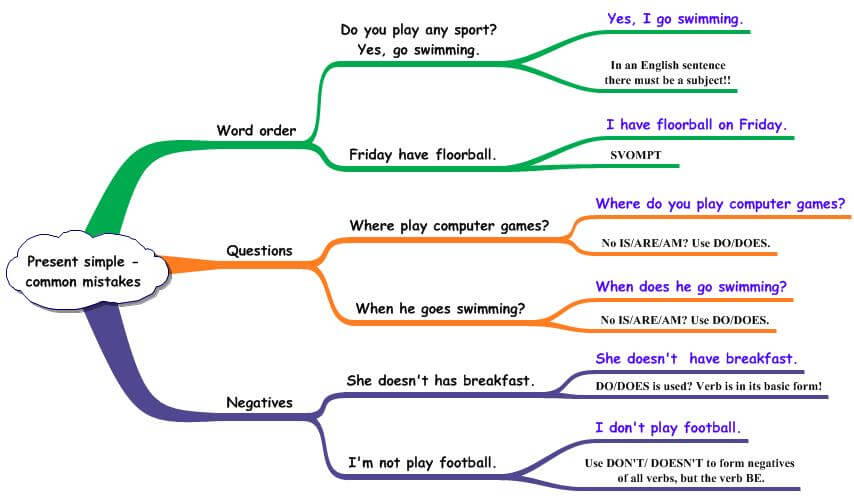
In the following infographic there are all the most common mistakes my students make in the present simple tense. I have divided the mistakes into three categories. First, my students struggle with questions (they often forget to use DO/DOES). Second, their negative sentences frequently miss something. And last but not least, they still do not stick to the SVOMPT word order.
In the mind map there are all the wrong sentences, their corrections and in blue ink there is an explanation why the sentence was wrong.
ADVERT:
[showmyads]
[su_spacer][su_heading]
Common mistakes – present simple – worksheet
[/su_heading][su_spacer]
Some might find it attractive to start the lesson with the mind map but I do it differently. I use an activity which I found in the book by Scott Thornbury called Teaching Unplugged. I copy all the wrong sentences – each on a separate piece of paper – and I place the sentences around the classroom. Students take a sheet of paper and a pen or pencil and go around the classroom. Their task is to copy and correct the sentences on the sheet. They can help each other. I stop the activity after ten minutes and then I elicit their corrected sentences.
Only after this activity I display the infographic and explain the mistakes.
Then it is time to hand out the following worksheet:
[su_button url=”https://engames.eu/wp-content/uploads/2015/11/Present-simple-worksheet.pdf” target=”blank” background=”#f56b68″ size=”6″]Common mistakes in present simple tense worksheet [/su_button]
In the worksheet there are four exercises. The first one is slightly unusual. First the students have to decide where the verbs go and then they have to put the words into the correct order. The rest of the exercises are all standard exercises.
[su_spacer][su_heading]
Common mistakes – present simple – games
[/su_heading][su_spacer]
The first game is called Penalty Shootout. In this game you should choose the correct form and then try to score a goal. Good luck.
As the game is in Flash, it will only play on desktop computers.
ADVERT:
[showmyadsa]
[su_button url=”https://engames.eu/common_mistakes/present simple/Present simple en garde.html” target=”blank” background=”#f56b68″ size=”6″]Present simple – Penalty game[/su_button]
[su_spacer]
To practise the present simple tense you can play the following game. Its name is En Garde. Your task is to choose the correct answer and then stop the target as close to the centre as possible. Hopefully, you will be faster and more accurate then your opponent. The game is in Flash and will play only on desktops:
[su_button url=”https://engames.eu/common_mistakes/present simple/Present simple penalty.html” target=”blank” background=”#f8d23c” size=”6″]Present simple – En Garde game[/su_button]
[su_spacer]
The following quiz can help your students practise the past simple tense at home. The quiz consists of two parts. In the first part, students should put the words into the correct order. In the second part, students have to put the verbs into the correct form. Students will be rewarded with a game after each part of the quiz they pass. The quiz is in HTML5, so it will play on all desktops and mobile devices.
[su_button url=”https://engames.eu/common_mistakes/present simple/Present simple tense quiz (Web)/index.html” target=”blank” background=”#f56b68″ size=”6″]Present simple tense – quiz[/su_button]

So helpfull, thank you.
no he podido usar los juegos y se miran interesantes, si me guías te agradecería
No es posible usar estos juegos. Están en Flash y eso no funciona.